Ahupuaʻa System Living in Balance: The Hawaiian ecoSystem and its Lessons for Modern Sustainability
By Scott Southworth · August 21, 2026
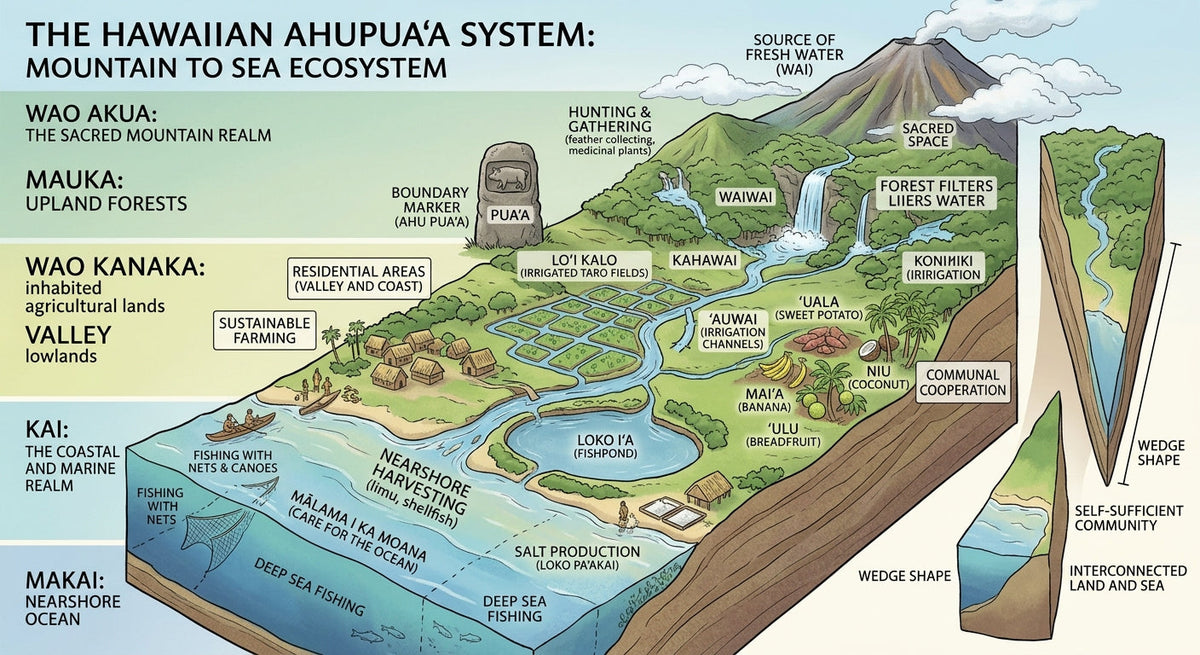
In an era of global climate disruption, resource depletion, and fragile supply chains, modern urban planners and environmental scientists are increasingly turning toward ancient wisdom for answers. Among the most sophisticated, sustainable models of human ecosystem management ever devised is the Ahupuaʻa system of ancient Hawaii.
Long before European contact, Native Hawaiians (Kānaka Maoli) developed an integrated, watershed-based land management system that sustained a population of nearly one million people on isolated islands—without synthetic fertilizers, fossil fuels, imported goods, or environmental degradation.
By dividing islands into self-contained, mountain-to-sea socioeconomic zones, the Ahupuaʻa established a harmonious balance between human needs and ecological conservation—offering a blueprint that modern society desperately needs today.
Part I: Anatomy of an Ahupuaʻa (Mountain to Sea)
An ahupuaʻa is a pie-shaped section of land that typically stretches from the high mountain peaks down through valleys, plains, and coral reefs into the open ocean. The name originates from ahu (stone altar) and puaʻa (pig)—marking the boundary where communities paid annual taxes (usually a pig or prized resources) to regional chiefs during the Makahiki festival.
Rather than drawing arbitrary straight lines across map coordinates, Hawaiians recognized that ecosystems are bound together by the movement of water. An ahupuaʻa was designed around a complete, self-sustaining watershed.
                        [ MOUNTAIN PEAK (*Uka*) ]
                                   │
         ┌─────────────────────────┼─────────────────────────┐
         ▼                         ▼                         ▼
 [ WAO AKUA ]              [ WAO KANAKA ]            [ KAI NAUUNALU ]
 (Upland Forest)          (Valley Agriculture)      (Coastal & Ocean)
 Sacred cloud forest       Villages, terraced loʻi   Fishponds, reefs,
 & water gathering         kalo, & fruit groves       open ocean fishing
An ahupuaʻa was divided into three primary ecological and functional zones:
1. Kahiki / Wao Akua (Upland Forests)
Located in the highest elevations, this cloud forest zone was considered the realm of the gods (akua). It was kept largely wild and untouched. Native forests absorbed rainfall, captured cloud moisture, and recharged freshwater aquifers. Access was restricted primarily to practitioners gathering medicinal plants, hardwoods for canoes, or sacred feathers.
2. Wao Kanaka (Mid-Elevation Valleys & Plains)
The realm of humanity (kanaka), where villages, agricultural terraces (loʻi kalo), and dryland crop systems (ʻuala / sweet potato, breadfruit, and sugar cane) flourished. Water diverted from mountain streams fed complex agricultural systems before returning safely back to the riverbeds.
3. Kahakai & Kai (Coastal Plain & Ocean)
The coastal interface where freshwater streams met the sea. Communities built stone fishponds (loko iʻa) in estuarine waters, harvested limu (seaweed), and fished the coral reefs and deep ocean (kai kohola).
Part II: The Socio-Economic Principles of Shared Resources
What made the ahupuaʻa system uniquely effective was not just its physical geography, but its social framework. It operated on a communal economy anchored by two foundational cultural concepts: kapu (sacred law) and aloha ʻāina (love and stewardship for the land).
               [ EQUITABLE RESOURCE EXCHANGE ]
 ┌─────────────────────────────────────────────────────────┐
 │                                                         │
 │  Upland Farmers  ───(Taro, Hardwood, Olonā Fiber)───►   │
 │         ▲                                      │        │
 │         │                                      ▼        │
 │  [ COMMON ACCESS ]                      [ BARTER & SHARED ]
 │         │                                      ▲        │
 │         ▼                                      │        │
 │  Coastal Fishermen ◄──(Fish, Salt, Limu Seaweed)─────   │
 │                                                         │
 └─────────────────────────────────────────────────────────┘
-
No Private Ownership: Land was held in trust by high chiefs (aliʻi) and managed by land stewards (konohiki), but nobody "owned" the land in the modern Western sense. People belonged to the land (ʻāina); the land did not belong to them.
-
Reciprocal Exchange: Mountain dwellers traded taro, wood, and plant fibers with coastal residents in exchange for fish, sea salt, and seaweed. This internal trade eliminated the need for currency or distant supply chains.
-
Adaptive Management (Kapu): The konohiki monitored resource levels closely. If a reef showed signs of overfishing or a crop suffered from drought, a seasonal kapu (prohibition) was declared, halting harvest until the ecosystem regenerated.
Part III: Ecological Engineering in Action
The Ahupuaʻa system was a masterclass in regenerative circular design, turning natural physical processes into self-replenishing agricultural engines.
| Ahupuaʻa System | Scientific & Ecological Mechanism | Modern Environmental Equivalent |
| Auwai Irrigation | Gravity-fed, unpaved stream diversions that cooled crops and returned clean water downstream | Regenerative stormwater & graywater recycling |
| Loko Iʻa (Fishponds) | Stone sluice gates (mākāhā) allowed juvenile fish in while trapping mature fish | Sustainable, zero-input mariculture |
| Loʻi Silt Trapping | Terraced taro fields caught mountain erosion, filtering sediment before it reached coral reefs | Constructed wetlands & runoff bio-filters |
| Forest Preservation | Protecting high-elevation canopy maximized fog drip and rainfall recharge | Watershed protection & carbon sinks |
The Power of the Mākāhā
A prime example of ancient hydraulic brilliance is the loko iʻa (fishpond). Built along the coast with lava-rock walls, these ponds featured wooden sluice gates called mākāhā.
The gaps in the wooden grates allowed small fish to swim inside from the ocean to feed on brackish-water algae (limu). As the fish grew fat on the nutrient-rich food, they became too large to fit back through the grates. Hawaiians created a self-stocking, natural ocean pantry that required no artificial feed, chemicals, or energy inputs.
Part IV: Lessons for Modern Sustainability
Today, urban centers are plagued by fragmented zoning, polluted agricultural runoff, destroyed wetlands, and extreme resource vulnerability. The principles of the ahupuaʻa offer critical solutions for modern environmental design:
1. Shift to Watershed-Based Urban Planning
Modern geopolitical borders (cities, counties, states) rarely align with natural topography. Consequently, upstream pollution becomes a downstream city's disaster. Adopting watershed-scale planning—managing water, waste, and development within natural river basins—restores ecosystem integrity.
2. Embrace Circular, Zero-Waste Economies
In the ahupuaʻa, the waste product of one sector was the fuel for another. Organic silt from mountain farming fertilized coastal estuaries rather than smothering coral reefs. Modern cities must transition from linear "take-make-dispose" models toward closed-loop circular systems for water, energy, and materials.
3. Practice Localized Food Security
Relying on thousands of miles of global supply chains leaves communities vulnerable to climate disruption. The ahupuaʻa proved that high population densities can be fed locally when agricultural systems mirror natural ecosystems (e.g., agroforestry, urban aquaponics, vertical farming).
4. Re-establish Aloha ʻĀina (Stewardship over Consumption)
Technological fixes alone cannot solve climate crises without a fundamental shift in mindset. Treating land as a living relative to be cared for—rather than a commodity to be exploited—ensures that economic decisions prioritize long-term ecological health over short-term profit.
Reclaiming the Ridge-to-Reef Vision
The ahupuaʻa system was not a primitive survival strategy; it was an advanced, scientifically grounded, and deeply spiritual framework for sustainable human existence.
As modern society faces pressing ecological challenges, the ancient Hawaiian philosophy of "Mālama ʻĀina"—caring for the land so the land cares for you—stands as a beacon of hope. By integrating modern technology with the holistic, ridge-to-reef principles of the ahupuaʻa, we can build resilient, sustainable communities capable of thriving for generations to come.