Hawaiian Canoe Plants: Living Cargo - The History, Uses, and Cultural Value
By Scott Southworth · August 21, 2026
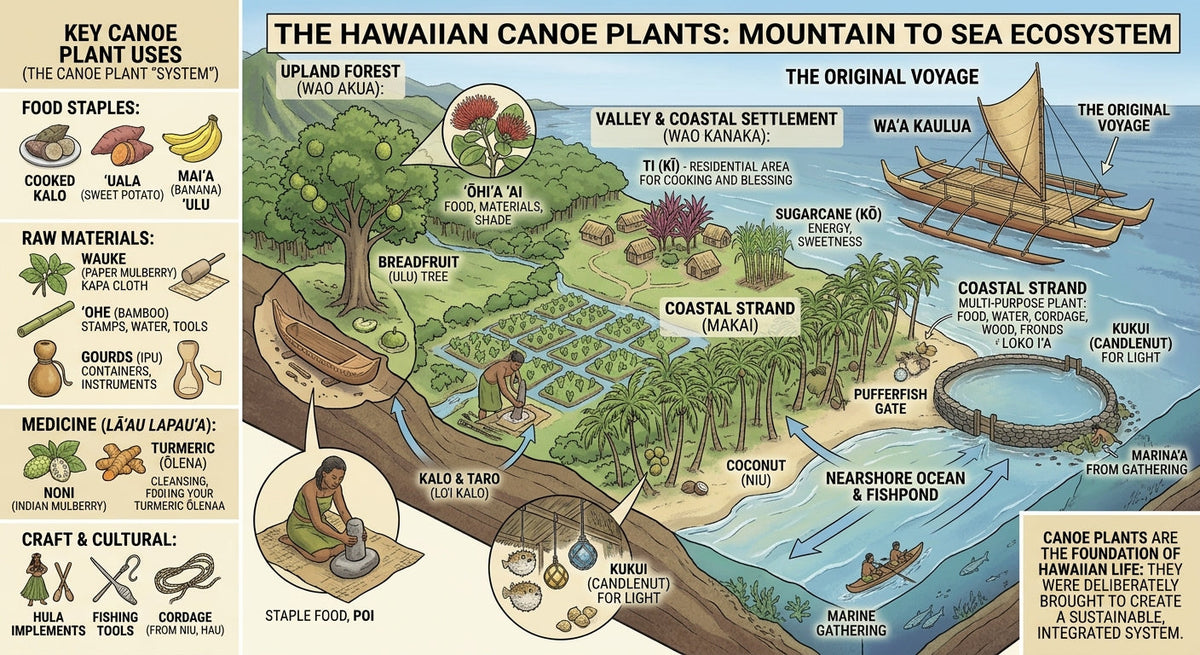
When ancient Polynesian navigators set sail into the vast Pacific Ocean to settle the Hawaiian archipelago over a thousand years ago, they were not embarking on a one-way survival trip. These voyages were carefully planned expeditions of settlement.
Packed into the narrow hulls of double-hulled voyaging canoes (waʻa kaulua) alongside livestock and family members were roughly 27 to 30 essential plant species. Known collectively today as Canoe Plants, these living botanical specimens were selected to reproduce a complete, self-sustaining civilization on isolated volcanic islands.
Without native mammalian livestock or fruit orchards waiting for them in Hawaii, the voyagers carried everything required to build homes, make clothing, craft weapons, light the night, treat illnesses, and nourish future generations.
Part I: The Logistics of Botanical Survival
Transporting living plant cuttings across thousands of miles of salt spray, scorching sun, and turbulent seas required extraordinary botanical knowledge.
Navigators created specialized packing techniques to keep roots and tubers alive during weeks at sea:
                  [ VOYAGING CANOE BOTANICAL STORAGE ]
                                   │
      ┌────────────────────────────┼────────────────────────────┐
      ▼                            ▼                            ▼
[ DRY TUBERS / CORMS ]     [ WRAPPED CUTTINGS ]       [ SEED NUTS ]
(Kalo & ʻUala packed in   (Ti & Sugar Cane wrapped    (Kukui & Niu stored in
 ti leaves & moss)        in damp moss & fiber)       dry, elevated baskets)
-
Moisture Barriers: Cuttings of kalo (taro) and ʻuala (sweet potato) were wrapped in damp moss and protected by thick, water-resistant lāʻī (ti leaves) to prevent dehydration.
-
Salt Spray Protection: Young saplings were kept elevated away from bilge water and shielded with woven pandanus mats (lauhala) to block ocean spray.
-
Selection for Propagational Speed: Voyagers prioritized species that could be propagated rapidly via vegetative cuttings or corms rather than slow-germinating seeds.
Part II: The Primary Pillars of Polynesian Survival
The introduced canoe plants were categorized by their essential roles in daily life, serving as food, textiles, construction materials, and medicine.
                           [ CANOE PLANT ROLES ]
                                     │
         ┌───────────────────────────┼───────────────────────────┐
         ▼                           ▼                           ▼
[ DIETARY STAPLES ]         [ MATERIAL CULTURE ]        [ LIGHT & MEDICINE ]
• Kalo (Taro)               • Kapa / Wauke (Barkcloth)  • Kukui (Candlenut)
• ʻUlu (Breadfruit)         • Niu / Coconut (Cordage)   • Noni (Healing Fruit)
• ʻUala (Sweet Potato)      • Lāʻī / Ti (Roofing/Wraps) • ʻOlena (Turmeric)
1. Dietary Staples (Nourishment for the Nation)
-
Kalo (Taro - Colocasia esculenta): The most sacred canoe plant, viewed as the elder brother of humanity. Pounded into poi, it formed the central starch of the Hawaiian diet.
-
ʻUlu (Breadfruit - Artocarpus altilis): A fast-growing tree producing heavy, starch-rich fruits. Its light wood was also used to carve canoe hulls and surfboard blanks.
-
ʻUala (Sweet Potato - Ipomoea batatas): Cultivated extensively in drier, upland regions where kalo could not thrive. It provided crucial food security during droughts.
-
Niu (Coconut - Cocos nucifera): The ultimate multi-use plant. The water provided sterile hydration on the ocean; the meat provided fats; and the fibrous husk (ahuʻawa) was braided into sennit cordage used to lash canoes, houses, and tools together.
2. Material Culture and Textiles
-
Wauke (Paper Mulberry - Broussonetia papyrifera): The inner bark of the wauke tree was harvested, soaked, and meticulously beaten with wooden beaters (iʻe kuku) to create kapa—the soft, durable cloth used for clothing, loincloths (mālo), skirts (pāʻū), and bed coverings.
-
Lāʻī / Kī (Ti Plant - Cordyline fruticosa): The versatile leaves were used as food wrappers for imu cooking, woven into rain capes, used for thatched roofs, and worn as protective amulets against negative energy.
3. Light, Medicine, and Dyes
-
Kukui (Candlenut - Aleurites moluccanus): The state tree of Hawaii. The oil-rich nuts were skewer-strung on coconut leaf ribs and burned one by one as candles. The oil was also used for body massage and waterproofing canoe hulls, while the bark and root produced rich dark dyes.
-
Noni (Indian Mulberry - Morinda citrifolia): A vital medicinal plant (laʻau lapaʻau). The pungent fruit juice was used to treat infections, skin afflictions, and digestive troubles.
-
ʻŌlena (Turmeric - Curcuma longa): Its golden rhizome was crushed to treat earaches and sinus inflammation, and used as a sacred yellow dye for ceremonial cloths.
Part III: Functional Matrix of Core Canoe Plants
| Plant Name | Hawaiian Name | Primary Use | Cultural / Spiritual Significance |
| Colocasia esculenta | Kalo | Poi, staple starch, leaf vegetable | Ancestral elder brother (Hāloa); spiritual core of the family |
| Cocos nucifera | Niu | Water, meat, rope cordage, timber | Symbol of high status and resourcefulness |
| Aleurites moluccanus | Kukui | Oil for light, dyes, body oil | Symbol of enlightenment, knowledge, and guidance |
| Broussonetia papyrifera | Wauke | Barkcloth (kapa) for clothing | Represents female artistry and domestic stewardship |
| Cordyline fruticosa | Kī / Ti | Food wrapping, capes, medicine | Sacred to the goddess Laka; clears negative energy |
Part IV: Ecological and Cultural Legacy
The introduction of canoe plants fundamentally transformed Hawaii's natural landscape. Settlers established sophisticated agroforestry systems—combining upland breadfruit groves (wao ʻulu), dryland sweet potato fields, and terraced wetland taro patches (loʻi kalo).
Rather than degrading their ecosystem, Native Hawaiians used these introduced plants to create a regenerative, closed-loop agricultural framework. Every plant had a dedicated space, a seasonal harvest cycle, and a sacred place in Hawaiian oral history.
Today, the legacy of canoe plants remains vital to Hawaii's cultural identity. From community restoration projects replanting native wauke and kalo to modern herbalists utilizing noni and ʻōlena, these ancestral species continue to nourish, heal, and connect modern generations directly to the extraordinary voyagers who brought them across the sea.