Hawaiian Fish Ponds and Farming :Trapping the Tides: The History, Engineering, and Marine Science of Hawaiian Loko Iʻa
By Scott Southworth · August 21, 2026
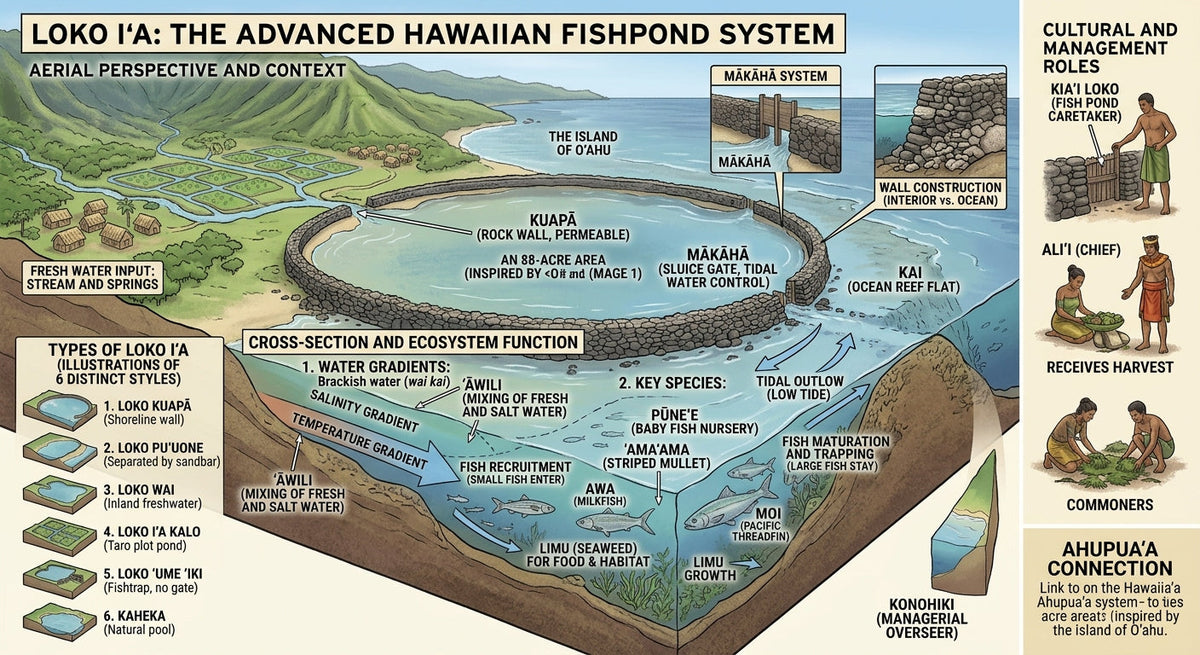
Long before modern aquaculture and industrial fish farming were conceived, the indigenous inhabitants of the Hawaiian Islands had already perfected a revolutionary, zero-input mariculture system. Known as loko iʻa (fishponds), these massive coastal stone structures represented one of the most sophisticated integrations of marine biology, hydraulic engineering, and ecological stewardship in the ancient world.
At their peak, hundreds of loko iʻa lined the coastlines of the Hawaiian archipelago, producing an estimated two million pounds of fish annually without depleting wild ocean stocks, introducing artificial feed, or causing environmental degradation.
Part I: The History and Royal Heritage of Loko Iʻa
In traditional Hawaiian society, the construction of a loko iʻa was a monumental civic undertaking sponsored by the aliʻi (high chiefs) and executed through the collective effort of the makaʻāinana (common people).
The earliest fishponds date back over a thousand years, but their development exploded between the 14th and 18th centuries under legendary rulers like Chief Kalamakua of Oahu, who organized the building of extensive pond systems along Pearl Harbor (Puʻuloa) and Waikiki.
                      [ THE ROYAL FISH POND (LOKO IʻA) ]
                                      │
          ┌───────────────────────────┴───────────────────────────┐
          ▼                                                       ▼
 [ SOCIO-POLITICAL VALUE ]                               [ ECOLOGICAL SECURITY ]
 • Symbol of chief's wealth & power                      • Living food reserve during storms
 • Fed the royal court & community                       • Protected wild ocean fish stocks
 • Managed under strict *Kapu* laws                      • Filtered mountain runoff & silt
The Royal Pantry
Loko iʻa served as living larders. During seasons of heavy ocean storms, when canoes could not venture past the breaking surf into deep waters, the fishpond guaranteed a steady, immediate supply of fresh protein for the community.
Ponds were governed by strict kapu (sacred laws). Specific species were harvested only at designated times, and the taking of undersized fish or overharvesting was severely punished. The health of the fishpond was directly tied to the spiritual and physical prestige of the chief; a thriving, productive pond demonstrated that the aliʻi ruled with righteousness (pono).
Part II: Hydraulic Engineering and Structural Anatomy
Constructing an offshore stone wall capable of withstanding heavy wave action, Pacific swells, and shifting tides required profound civil engineering knowledge.
Hawaiians built several distinct types of fishponds, but the most iconic and engineered was the loko kuapā—a coastal pond enclosed by a heavy seawall built directly on submerged reef flats.
                        [ CROSS-SECTION OF A LOKO KUAPĀ ]
 ┌────────────────────────────────────────────────────────────────────────┐
 │                                                                        │
 │  OCEAN TIDES (High Salinity / Oxygenated)                              │
 │            │                                                           │
 │            ▼                                                           │
 │   [ Outer Boulder Layer ] ──► Basalt Rocks interlocking without mortar │
 │   [ Interior Core ]       ──► Porous Coral & Lava Gravel Fill          │
 │   [ Inner Boulder Layer ] ──► Retaining Wall facing the pond           │
 │            ▲                                                           │
 │            │                                                           │
 │  POND INTERIOR (Brackish / Nutrient-Rich / Calm)                       │
 │                                                                        │
 └────────────────────────────────────────────────────────────────────────┘
1. The Mortarless Seawall (Kuapā)
The perimeter wall (kuapā) was constructed using heavy basalt boulders (pōhaku) and coral heads. Crucially, no mortar or cement was used.
-
Flexibility: Without rigid mortar, the wall could flex slightly under the kinetic energy of striking ocean waves without cracking or collapsing.
-
Porosity: The porous construction allowed ocean water to seep steadily through the rocks during tidal changes, preventing pressure buildup behind the wall while constantly flushing the interior of the pond with oxygenated seawater.
2. The Core Filling
Between the outer and inner boulder faces, workers packed small lava cinders, coral gravel, and sand. This dense core acted as a natural physical filter, trapping large debris and sea predators while allowing microscopic nutrients and water to pass through freely.
Part III: The Marine Science of the Mākāhā (Sluice Gate)
The true technological masterpiece of the loko iʻa is the mākāhā—a wooden sluice grate placed in the channels connecting the pond to the open ocean.
                     [ THE OPERATION OF THE MĀKĀHĀ ]
                                    │
         ┌──────────────────────────┴──────────────────────────┐
         ▼                                                     ▼
 [ HIGH TIDE (Inflow) ]                                [ LOW TIDE (Outflow) ]
 • Cool, salty ocean water enters                      • Brackish water flows out
 • Tiny juvenile fish (*ʻāhua*) enter                  • Mature fish swim to gate
 • Sunlight drives algae bloom                         • Harvested easily by net
The mākāhā operated on simple yet profound biological and fluid-dynamic principles:
1. Automatic Selective Trapping
The mākāhā consisted of vertical wooden slats (made from dense woods like alaheʻe or lama) spaced roughly one inch apart.
-
Entry: Tiny juvenile fish—such as ʻamaʻama (striped mullet) and awa (milkfish)—swam freely into the pond from the open ocean through the narrow gaps, seeking calm water and protection from deep-sea predators.
-
Growth & Entrapment: Inside the nutrient-rich pond, the juvenile fish fed continuously and grew rapidly. Within a few months, their bodies became too wide to fit back through the wooden slats. They were safely trapped inside—not by hooks or nets, but by their own physical growth.
2. Tidal Energy and Oxygenation
As the ocean tide rose and fell, water rushed through the narrow mākāhā channel, creating a localized current. Fish naturally swim against currents (rheotaxis) to receive oxygen-rich water. During high tide, mature fish gathered in massive numbers directly behind the mākāhā, allowing practitioners to easily harvest specific quantities using throw nets without disturbing the rest of the pond population.
Part IV: Estuarine Biology and the Algal Food Engine
A loko iʻa was not merely a holding pen; it was a highly managed primary production engine based on estuarine ecology.
The most productive fishponds were constructed where freshwater mountain streams (wai) met the salt water of the ocean (kai), creating a low-salinity, nutrient-dense environment known as brackish water.
  [ FRESHWATER RUNOFF ]             [ OCEAN TIDES ]
  (Nitrates, Silicates, Soil)       (Salinity, Oxygen, Larvae)
               │                                │
               └───────────────┬────────────────┘
                               ▼
                   [ BRACKISH ENVIRONMENT ]
                               │
                               ▼
               [ RAPID *LIMO* / ALGAE GROWTH ]
                               │
                               ▼
             [ HERBIVOROUS FISH (*ʻAmaʻama* & *Awa*) ]
The Food Web Shift
Industrial fish farms often rely on feeding carnivores (like salmon) meal derived from other wild fish, creating a net loss in ocean biomass. Native Hawaiians avoided this trap by populating their ponds almost exclusively with herbivorous fish.
-
Nutrient Inflow: Freshwater streams carried volcanic silicates and organic nitrates down from mountain forests into the shallow pond.
-
Solar Heating: Fishponds were built shallow—typically 2 to 3 feet deep—allowing sunlight to penetrate all the way to the floor, warming the brackish water.
-
Algae Boom: The combination of shallow sunlight, warm temperatures, and stream nutrients triggered massive growth of benthic microalgae (microscope limu) and soft filamentous algae.
-
Efficient Conversion: Herbivorous species like ʻamaʻama grazed directly on the abundant algae. By harvesting primary consumers (herbivores) rather than secondary consumers (predators), the fishpond converted solar energy and soil nutrients into edible protein at maximum thermodynamic efficiency.
If predatory species (such as the kākū / barracuda or ʻōʻio / bonefish) entered the pond through damaged walls, pond caretakers (kiaʻi loko) used specialized lures and nets to remove them immediately, preserving the herbivorous population.
Lessons for Modern Aquaculture and Coastal Restoration
With global ocean stocks facing unprecedented pressures from overfishing and ocean acidification, the ancient principles of the loko iʻa offer invaluable lessons for modern marine management:
-
Passive Hydrodynamics over Mechanical Inputs: Utilizing natural tidal energy and tidal flushing eliminates the fossil-fuel pumps and artificial aeration required by modern land-based fish farms.
-
Herbivorous Focus for True Sustainability: Shifting commercial mariculture toward herbivorous and omnivorous species reduces reliance on fishmeal made from wild-caught forage fish.
-
Estuarine Preservation: Protecting the natural flow of clean freshwater streams into coastal ecosystems is essential for sustaining ocean fisheries and coastal biological productivity.
The Hawaiian stone fishpond stands as a historic triumph of indigenous science—a harmonious blending of physics, biology, and civil engineering that proved humanity can enhance and expand nature's productivity while honoring the delicate balance of the sea.