Taro Poi -The Heart of the Island: The History, Science, and Sacred Roots of Hawaiian Kalo and Loʻi Farming
By Scott Southworth · August 18, 2026
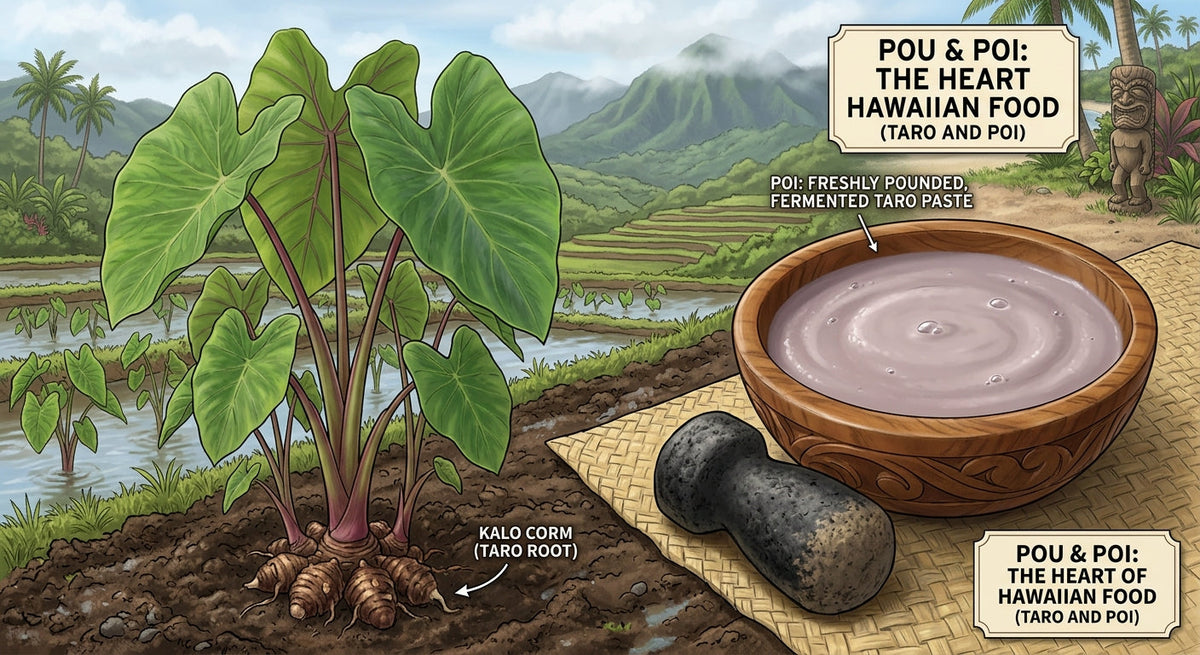
To step into a flooded loʻi kalo (taro patch) in Hawaii is to stand at the absolute center of Hawaiian identity.
With mountains rising sharply in the background and cool freshwater rushing over your feet, you gaze across quiet, muddy terraces filled with heart-shaped leaves swaying on long, graceful stalks. To a casual observer, it looks like a picturesque scene of tropical agriculture. But to the native Hawaiian people (Kānaka Maoli), a loʻi kalo is not merely a farm. It is a living sanctuary, an engineering marvel, and a family reunion spanning thousands of years.
Kalo (known elsewhere in the Pacific as taro) is the most sacred plant in Hawaiian culture. It is the botanical ancestor of the human race, the primary starch that nourished a civilization, and the foundation of a sustainable agricultural system that fed nearly a million people on isolated islands without chemical fertilizers or metal tools.
Part I
In Hawaiian cosmology, the relationship between human beings and kalo is genealogical.
Harvesting Taro was never treated as backbreaking farm work or commercial labor. It was a spiritual duty—caring for the each other who, in turn, kept the human family alive.
Part II: The Botanical Science of Colocasia esculenta
From a botanical perspective, kalo (Colocasia esculenta) is an extraordinary root vegetable belonging to the Araceae family. Ancient Hawaiians were master botanists who identified, named, and cultivated over 300 distinct varieties of kalo, each adapted to specific soil conditions, rainfall levels, and culinary uses.
                   [ ANATOMY OF A KALO PLANT ]
 ┌───────────────────────────────────────────────────────────────┐
 │                                                               │
 │               Lāʻī / Hā (Heart-Shaped Leaf & Stalk)           │
 │                     \                                         │
 │                      \                                        │
 │                       \                                       │
 │                 ┌──────┴──────┐                               │
 │                 │  Kalo Corm  │  (Primary Starch / Food)      │
 │                 └──────┬──────┘                               │
 │                        │                                      │
 │                  ┌─────┴─────┐                                │
 │                  ▼           ▼                                │
 │              [ ʻOhā ]     [ ʻOhā ]   (Offshoots / Next Gen)   │
 │                                                               │
 └───────────────────────────────────────────────────────────────┘
The plant consists of four primary structural components:
-
Kalo (Corm): The swollen, underground starch stem that serves as the main food source.
-
Hā (Petiole/Stalk): The long stem connecting the corm to the leaf, named after the hā (breath of life).
-
Lāʻū / Lūʻau (Leaf): The large, heart-shaped leaf that gathers sunlight and gives its name to traditional Hawaiian feasts.
-
ʻOhā (Offshoots): The small corms branching out from the main parent root—the linguistic origin of the word ʻohana (family).
Raw Toxicity vs. Cooked Nutrition
In its raw state, every part of the kalo plant contains microscopic, needle-sharp crystals of calcium oxalate. If eaten raw, these crystals cause intense burning, swelling, and irritation in the mouth and throat—a natural defense mechanism against herbivores.
To make kalo edible, it must be cooked thoroughly with heat and moisture for hours. High heat breaks down the calcium oxalate crystals, transforming the corm into a highly digestible, hypoallergenic starch rich in complex carbohydrates, potassium, fiber, and essential minerals.
Part III: The Engineering Marvel of the Loʻi System
While kalo can be grown in dry soil (kalo maloʻo), the most productive method was wetland cultivation: the loʻi kalo.
A loʻi is a terraced, flooded field enclosed by earthen walls (kuāuna). But a loʻi does not exist in isolation. It is part of an interconnected, watershed-scale engineering system known as the Ahupuaʻa—a pie-shaped land division extending from the mountain peaks (uka) down to the sea (kai).
                 [ THE MOUNTAIN-TO-SEA AHUPUAʻA WATER FLOW ]
 ┌─────────────────────────────────────────────────────────────────┐
 │                                                                 │
 │   [ MOUNTAIN RUNOFF / STREAM (*Wai*) ]                          │
 │         │                                                       │
 │         ▼                                                       │
 │   [ AUWAI (Irrigation Canal) ]                                  │
 │         │                                                       │
 │         ▼                                                       │
 │   [ TERRACED LOʻI KALO (Water cooled & enriched by plants) ]    │
 │         │                                                       │
 │         ▼                                                       │
 │   [ RETURN CANAL TO STREAM ]                                    │
 │         │                                                       │
 │         ▼                                                       │
 │   [ LOKO IʻA (Coastal Fishponds enriched by nutrients) ]        │
 │                                                                 │
 └─────────────────────────────────────────────────────────────────┘
Passive Hydraulic Engineering
Ancient Hawaiians constructed gravity-fed irrigation canals called ʻauwai. Water was diverted from cold mountain streams into the highest loʻi terrace. From there, it flowed gently from one stepped terrace to the next before returning cleanly to the main stream.
This system accomplished three critical agricultural goals:
-
Temperature Regulation: Kalo roots rot if water becomes stagnant or warm. The continuous flow of cold mountain water kept soil temperatures low, preventing fungal diseases.
-
Nutrient Transport: The water carried rich, organic mountain sediment and volcanic minerals directly into the fields, naturally fertilizing the crops without synthetic chemicals.
-
Downstream Ecosystem Support: As water flowed through the loʻi, the plants filtered out excess silt. When the water returned to the stream and entered coastal fishponds (loko iʻa), it was clean, cool, and rich in microscopic nutrients that fed fish populations.
In ancient Hawaiian law, water (wai) was never owned by individuals. The word for wealth was waiwai—meaning "abundance of water." A person's prosperity was measured by how efficiently they managed water to feed their neighbors while leaving plenty of clean water for those downstream.
Part IV: The Science and Ritual of Poi
The ultimate culinary expression of kalo is poi.
To make traditional poi, cooked kalo corms are peeled and placed on a heavy wooden carving board called a pāhoa. Using a smooth, hand-carved stone pestle (pōhaku kuʻi poi), the practitioner rhythmically pounds the kalo, adding small amounts of fresh water until it transforms into a smooth, purple-grey paste.
| Stage of Poi | Texture & Preparation | Culinary & Cultural Role |
| Paʻi Kalo | Thick, dense paste with minimal water | Concentrated form stored in ti leaves for long voyages |
| Fresh Poi | Smooth, sweet starch mixed with water | Eaten fresh; mild, nutty flavor profile |
| Fermented Poi | Naturally fermented (1-3 days old) | Tangy, probiotic-rich starch essential for digestion |
[ COOKED KALO CORM ] ──► (Pound with Stone & Water) ──► [ PAʻI KALO ] ──► [ FERMENTED POI ]
The Probiotic Starch
When left at room temperature, poi undergoes natural lactic acid fermentation, similar to yogurt or sourdough. Beneficial wild lactobacillus bacteria convert simple sugars into organic acids, lowering the pH.
This natural fermentation preserved poi for weeks without refrigeration in Hawaii's warm climate. Furthermore, the probiotics made poi exceptionally gentle on the human digestive tract—so much so that it was traditionally used as a weaning food for infants and a health restorative for elders.
The Modern Reclamation of the Loʻi
Following the overthrow of the Hawaiian Kingdom and the rise of 20th-century sugar cane and pineapple plantations, vast numbers of traditional ʻauwai canals were diverted, and centuries-old loʻi terraces dried up.
However, over the last several decades, a powerful cultural renaissance has taken root across the islands. Community groups, schools, and native families are clearing overgrown jungle, restoring stone walls, reopening ancient ʻauwai canals, and stepping back into the mud.
Working in a loʻi kalo teaches a lesson that modern industrial agriculture often forgets: that human food systems can enrich nature rather than destroy it. When you care for the elder brother Hāloa, you care for the land, the water, the community, and the future.