The Hawaiian Imu - Fire Beneath the Earth: The Engineering, History, and Science
By Scott Southworth · August 18, 2026
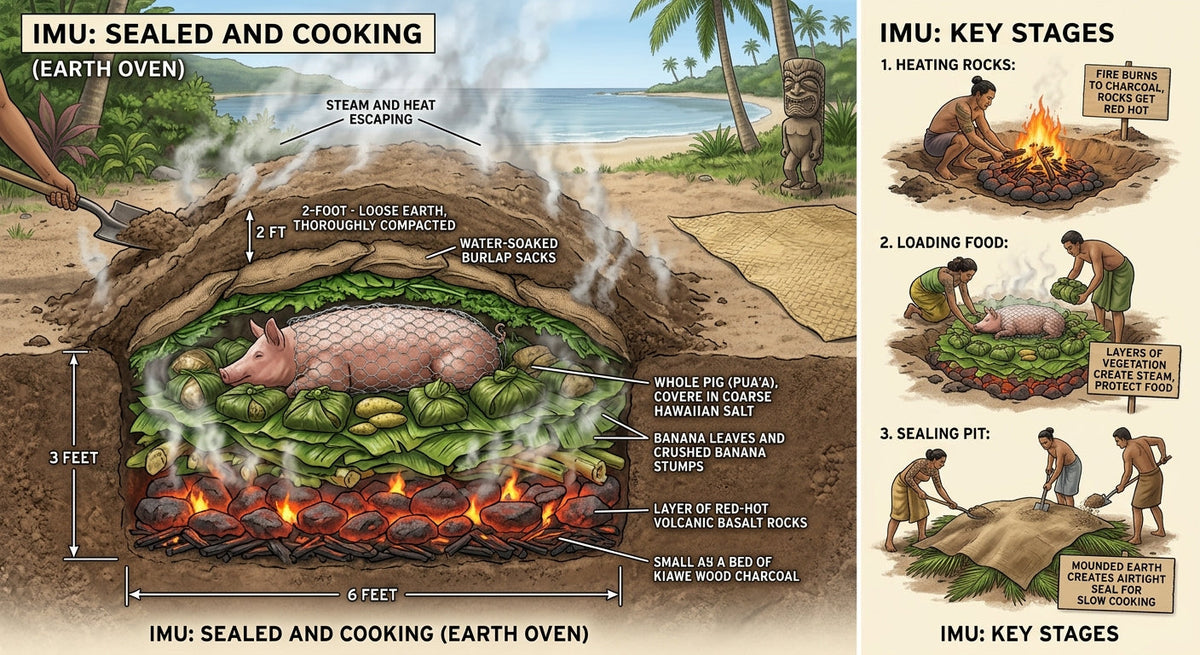
Long before the invention of stainless-steel smokers, convection ovens, or modern thermodynamics, Polynesian navigators arrived in Hawaii with a mastery of subterranean engineering. To feed entire communities without metal pots or closed ovens, they turned to the most abundant resources around them: volcanic rock, native timber, banana trees, and the earth itself.
The result was the imu—the traditional Hawaiian earth oven.
To the untrained eye, an imu might look like little more than a dirt pit with smoke billowing out of the ground. But behind that rising steam lies a sophisticated thermal battery, a closed-loop pressure cooker, and a deep cultural institution. For centuries, the imu has transformed tough starches and meats into smoky, tender masterpieces, serving as the physical and culinary heart of Hawaiian community life.
Part I: The History and Sacred Role of the Imu
In traditional Hawaiian society, cooking in an imu was never an everyday individual task; it was a communal event built around kuleana (shared responsibility) and ʻohana (family connection).
Major celebrations, religious ceremonies, and community feasts (ʻahaʻaina) required feeding hundreds of people simultaneously. Because traditional Hawaiian homes (hale) were built of wood and thatch, indoor fires were hazardous. The solution was the kāheumu—the outdoor cooking area where men gathered to dig, prepare, and manage the imu.
                    [ COMMUNITY IMU PREPARATION ]
                                  │
         ┌────────────────────────┴────────────────────────┐
         ▼                                                 ▼
 [ HEAVY PHYSICAL LABOR ]                         [ SACRED RESPONSIBILITY ]
 • Digging pit & carrying rocks                   • Chanting (*Oli*) for gratitude
 • Harvesting hardwood & banana stalks            • Caring for the community's food
 • Tending 800°F volcanic stones                  • Maintaining spiritual purity (*Pono*)
Under the ancient Kapu system—the strict code of societal and religious laws—men performed the heavy labor of preparing the imu. This was considered both a physical necessity and a sacred duty. The process was accompanied by chants (oli) asking for blessings on the food, thanking the earth for its thermal energy, and honoring the ancestors who passed down the technique.
When a family built an imu, they weren't just making dinner. They were opening a direct dialogue with the land (ʻāina), utilizing its natural elements to sustain the human body.
Part II: Thermal Engineering (How the Imu Holds Heat)
From a mechanical and thermal engineering perspective, the imu is a brilliant utilization of heat storage and transfer principles. It operates on four distinct thermal phases: heat absorption, radiant conduction, convective trapping, and steam pressure.
1. Digging the Basin
The pit itself is dug into dry earth or sand, typically 2 to 4 feet deep and 4 to 6 feet wide, depending on the volume of food. The bowl-like shape is crucial: it concentrates radiant heat toward the center.
2. The Fuel and the Volcanic Battery
At the bottom of the pit, dry hardwood—traditionally kiawe (mesquite) or ʻōhiʻa—is stacked in a precise lattice pattern. On top of the wood, heavy basalt river stones (pōhaku) are carefully layered.
                       [ CROSS-SECTION OF AN IMU ]
 ┌────────────────────────────────────────────────────────────────────────┐
 │                                                                        │
 │   Layer 6: Dirt & Woven Canvas/Burlap (Pressure Seal)                   │
 │   ──────────────────────────────────────────────────────────────────   │
 │   Layer 5: Ti Leaves & Banana Leaves (Aromatic Flavor Barrier)         │
 │   ──────────────────────────────────────────────────────────────────   │
 │   Layer 4: Food (Kalua Pork, Kalo, Uala) wrapped in Ti Leaves         │
 │   ──────────────────────────────────────────────────────────────────   │
 │   Layer 3: Shredded Banana Stalks (*Pūnana*) (Moisture & Steam Source)  │
 │   ──────────────────────────────────────────────────────────────────   │
 │   Layer 2: Superheated Basalt Rocks (*Pōhaku*) (Thermal Battery)        │
 │   ──────────────────────────────────────────────────────────────────   │
 │   Layer 1: Ash bed from Kiawe/ʻŌhiʻa Hardwood Fuel                      │
 │                                                                        │
 └────────────────────────────────────────────────────────────────────────┘
Not just any rock will do. Ocean-soaked porous stones or river rocks containing trapped internal water will explode under intense heat. Practitioners select dense, smooth basalt stones that have been thoroughly dried. Basalt possesses a high specific heat capacity—meaning it absorbs immense amounts of heat energy without shattering and releases it slowly over many hours.
The fire burns for 2 to 3 hours until the wood collapses into glowing coals and the stones glow cherry-red, reaching temperatures between 800°F and 1,000°F (425°C - 535°C).
Part III: The Culinary Science of Steam and Smoke
Once the rocks are superheated, the cooking method shifts from direct fire to a combination of radiant heat, conductive contact, and high-pressure steam. This is where the chemistry of cooking transforms the ingredients.
| Layer Component | Native Hawaiian Name | Scientific & Culinary Function |
| Hardwood Coals | Liʻa / Laʻau | Provides initial high heat; imparts deep smoky phenols to the pit. |
| Basalt Rocks | Pōhaku Imu | Acts as a long-duration thermal battery releasing steady radiant heat. |
| Banana Stalks | Pūnana | Crushed stalks release high moisture content, generating instant steam. |
| Ti Leaves | Lāʻī | Natural non-stick barrier; releases sweet, tea-like aromatic flavor (alkaloids). |
| Earth Cover | Lepo | Traps steam, creating a high-humidity, pressurized cooking chamber. |
The Moisture Engine
Before food touches the hot rocks, practitioners lay down crushed banana stalks (pūnana) and lush green ti leaves (lāʻī). The extreme heat hits the water-rich banana stalks, instantly converting their liquid content into a massive cloud of trapped steam.
The Science of Tenderness (Kalua)
The term kalua literally translates to "to cook in an underground oven." When a whole pig (puaʻa), taro corms (kalo), or sweet potatoes (ʻuala) are placed in the imu, three distinct chemical reactions occur over 8 to 12 hours:
-
Collagen Hydrolysis: Tough connective tissues (collagen) in meats begin breaking down at temperatures above 160°F (71°C). In the high-humidity environment of the imu, collagen slowly dissolves into gelatin, rendering even the toughest cuts remarkably tender and juicy.
-
Maillard Reaction & Phenol Absorption: The smoke from the wood embers and the natural sugars in the ti leaves interact with meat proteins. Even without direct flame exposure, the food undergoes a slow Maillard reaction, developing a deep, savory flavor profile.
-
Flavonoid Diffusion: As ti leaves steam, they release subtle compounds that permeate the meat, imparting an earthy, slightly sweet fragrance that cannot be replicated by liquid smoke or modern slow cookers.
Part IV: Sealing the Earth Pressure Cooker
Once the food is arranged on the leaf bed, more ti leaves and wet banana leaves are piled high over top. In ancient times, woven pandanus mats (lauhala) were placed over the leaf layers; today, damp burlap sacks and heavy canvas tarps are commonly used.
Finally, soil (lepo) is shoveled over the entire mound, completely sealing every crack and air vent.
[ STEAM ESCAPING ] ──► (Shovel Dirt over Hole) ──► [ PERFECT PRESSURE SEAL ]
If smoke or steam escapes through a fissure, it means heat energy and moisture are escaping. Men monitor the imu closely during the first hour, shoveling dirt onto any escaping wisps of smoke to maintain a tight seal.
Inside the sealed earth mound, temperatures stabilize around 220°F to 250°F (104°C - 121°C). The pit functions as a low-temperature, high-humidity pressure cooker. For the next 8 to 12 hours, time and thermodynamics do the work beneath the quiet earth.
The Unearthing: An Enduring Legacy
Unearthing an imu—a process known as huʻe i ka imu—is a moment of pure anticipation.
As the dirt is carefully shoveled away and the steaming burlap mats are lifted, a cloud of aromatic steam rises into the air—rich with the scent of roasted meat, sweet taro, smoky hardwood, and fresh ti leaves. The pig's skin falls away effortlessly, and the meat pulls apart with a simple touch of a finger.
In an age dominated by instant-gratification technology, digital timers, and microwave cooking, the Hawaiian imu stands as a monument to patience, natural engineering, and ecological wisdom. It reminds us that with a clear understanding of heat, rocks, plants, and community, human beings can turn the earth itself into an extraordinary kitchen.