The Rum War: The Epic Rivalry of Donn Beach, Trader Vic, and the Battle for the Mai Tai
By Scott Southworth · August 18, 2026
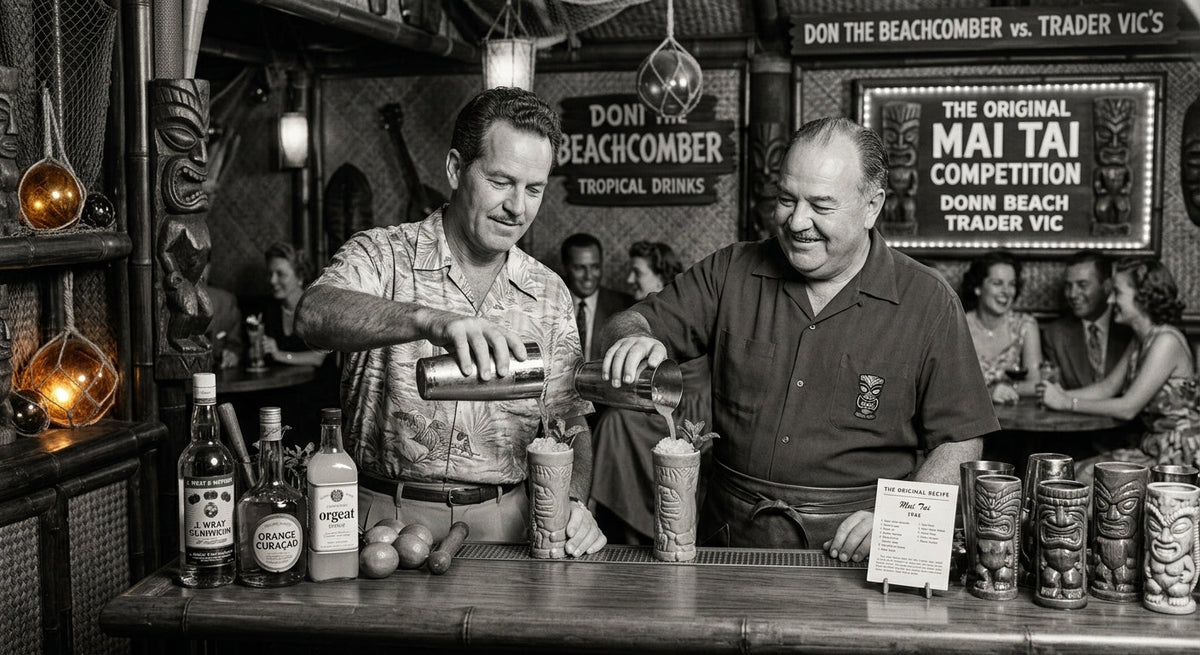
In the mid-20th century, two men transformed American drinking culture by selling a dream of South Seas paradise in a glass. One was a flamboyant Texas-born adventurer who surrounded himself with parrots and bamboo in Hollywood. The other was a sharp-witted, one-legged saloonkeeper from Oakland who built an international restaurant empire on wood-fired ovens and dry humor.
Their names were Donn Beach (born Ernest Gantt) and Victor "Trader Vic" Bergeron.
Together, they birthed Tiki culture—a billion-dollar design and culinary phenomenon that swept post-WWII America. But behind the thatched roofs, flickering torches, and ceramic mugs lay a fiercely competitive, decades-long rivalry. And at the absolute center of their feud was a single, glorious cocktail that both men claimed to have invented: The Mai Tai.
Part I: Two Visionaries, Two Philosophies
To understand the feud, one must first understand how fundamentally different the two men were in personality and approach.
Donn Beach was the artist-bohemian. After traveling the Caribbean and South Pacific in the late 1920s, Donn opened Don the Beachcomber in Hollywood in 1933. He was a master of atmosphere and mood, crafting theatrical, dark sanctuaries complete with indoor rain showers, hidden water pipes, and rum-heavy drinks so complex they were written in military-grade code. Donn saw himself as an auteur; the bar was his stage, and the guests were his audience.
                      [ THE TWO TIKI TITANS ]
                                 │
         ┌───────────────────────┴───────────────────────┐
         ▼                                               ▼
 [ DONN BEACH ]                                  [ TRADER VIC ]
 (Hollywood, 1933)                              (Oakland, 1934)
 • The Romantic Artist / Author                 • The Practical Businessman
 • Theatrical, mysterious, moody                • Warm, funny, hospitality-first
 • Coded recipes & multi-rum blends             • Accessible, bold, food-focused
Victor Bergeron, on the other hand, was the pragmatic businessman. In 1934, Vic borrowed $500 to open a tiny hunting-and-fishing tavern in Oakland, California, called Hinky Dinks. After visiting Donn’s Hollywood establishment in 1937, Vic was utterly captivated. He went home, renamed his bar Trader Vic's, covered the walls with fishnets and snowshoes, and began mixing exotic drinks.
Where Donn was mysterious and aloof, Vic was loud, profane, and fiercely welcoming. Having lost his left leg to a childhood ailment, Vic wore a wooden peg leg and routinely shocked guests with outrageous tall tales about how he lost it to a shark in the Pacific.
While Donn created the aesthetic, Vic scaled it into a global restaurant juggernaut.
Part II: The Clash of the Cocktail Titans
As both men expanded their empires throughout the 1940s and 50s, their rivalry deepened. Vic openly admitted that Donn was his initial inspiration—a confession that rankled Donn to his dying day. Donn viewed Vic as a latecomer who had copied his tropical decor, stole his Cantonese-fusion dining concept, and built a massive fortune on his original groundwork.
| Design & Business Dimension | Don the Beachcomber | Trader Vic's |
| Origin Location | McCadden Place, Hollywood (1933) | 65th Street, Oakland (1934) |
| Atmospheric Vibe | Dark, moody, intimate, mysterious | Energetic, convivial, lodge-meets-tropics |
| Culinary Focus | Cantonese-American "Exotic" dishes | Wood-fired Chinese oven meats & island fusion |
| Business Strategy | Boutique, artisan, artistic integrity | Global franchise empire, packaged sauces, books |
The tension wasn't just about decor—it was about credit. Donn was a perfectionist who guarded his drink specs with fanatic secrecy, using numbered decanters so even his own bartenders didn't know what they were pouring. Vic took those exotic flavor concepts, simplified them for rapid service, published them in bestselling cocktail books, and sold bottle mixes directly to grocery stores.
To Donn, Vic was commodifying an art form. To Vic, Donn was a secretive dreamer who missed out on building a real business empire.
Part III: The Mai Tai Mystery (1933 vs. 1944)
No single battle in cocktail history is as infamous as the war over who created the Mai Tai.
                       [ THE MAI TAI BATTLEFIELD ]
                                    │
         ┌──────────────────────────┴──────────────────────────┐
         ▼                                                     ▼
 [ DONN'S CLAIM (1933) ]                               [ VIC'S CLAIM (1944) ]
 "Q.B. Cooler"                                         17-Year Wray & Nephew
 • Complex blend of rums                               • Aged Jamaican Rum
 • Lime, orange juice, falernum                        • Fresh Lime, Orgeat (almond)
 • Cinnamon, honey, soda                               • Curaçao, Rock Candy Syrup
Trader Vic's Account (1944)
According to Victor Bergeron, the Mai Tai was born on a warm afternoon in Oakland in 1944. Vic was standing at his bar with a bottle of 17-year-old Wray & Nephew Jamaican rum—a rich, pungent, amber spirit. Wanting to highlight the magnificent rum without drowning its flavor, Vic added:
-
Fresh lime juice
-
French Orgeat (almond syrup)
-
Orange Curaçao
-
Rock candy syrup
He shook it over crushed ice and handed it to two friends visiting from Tahiti, Ham and Carrie Guild. Upon taking a sip, Carrie allegedly exclaimed: "Mai Tai—Roa Aʻe!" (Tahitian for "Out of this world—the best!"). Vic dubbed the drink the Mai Tai, and history was made.
Donn Beach's Counterclaim (1933)
Donn Beach and his supporters vehemently disputed Vic's origin story. Donn claimed he had created the precursor to the Mai Tai back in 1933, calling it the Q.B. Cooler (Quiet Village Cooler).
Donn’s recipe was a far more complex mix containing multiple rums, lime juice, orange juice, falernum, honey, and a dash of Angostura bitters. Donn argued that Vic had simply tasted the Q.B. Cooler at his Hollywood bar, stripped down the recipe to make it easier to mix, swapped honey for orgeat, and rebranded it under a catchy Tahitian name.
[ DONN'S Q.B. COOLER ] ──► (Tweak rums, swap honey for orgeat) ──► [ VIC'S MAI TAI ]
Part IV: The Lawsuit and the Verdict of History
The rivalry came to a legal boil in 1970. Trader Vic’s company was supplying the royal Hawaiian hotels with Mai Tai mix, and a rival distributor began marketing a "Don the Beachcomber Mai Tai."
Bergeron sued for copyright infringement and brand ownership. During the legal proceedings, Vic famously declared: "Anybody who says I didn't create the Mai Tai is a dirty stinkin' liar!"
                 [ THE LEGAL & CULINARY RESOLUTION ]
                                  │
         ┌────────────────────────┴────────────────────────┐
         ▼                                                 ▼
 [ COURT SETTLEMENT ]                             [ DRINK HISTORIANS ]
 Vic won exclusive brand rights                  Vic created the 1944 Mai Tai;
 to the name "Mai Tai"                           Donn inspired the flavor profile
The courts ultimately settled in Vic’s favor regarding commercial rights. Cocktail historians like Jeff "Beachbum" Berry later decoded both original recipes from secret hand-written notebooks. The consensus among modern mixologists is nuanced:
-
Trader Vic created the Mai Tai as we know it today—a elegant 1944 showcase for aged Jamaican rum, lime, and orgeat.
-
Donn Beach created the flavor archetype—his 1933 Q.B. Cooler laid the structural template (rum + lime + citrus + spice/nut syrup) that Vic refined.
The Legacy of the Titans
Donn Beach passed away in 1989 in Hawaii, remaining the undisputed spiritual godfather of Tiki aesthetics. Victor Bergeron passed away in 1984, leaving behind a global empire of restaurants that kept tropical cocktail culture alive through the dark ages of premixed bar mixes.
Without Donn’s poetic imagination, Tiki design would never have existed. Without Vic’s sharp instincts and legendary 1944 recipe, the world would never have tasted the Mai Tai.
Today, when you sit at a dimly lit craft bar and order a properly made Mai Tai—shaken with fresh lime, rich orgeat, and aged dark rum—you are sipping on the sweetest outcome of the greatest rivalry in American drink history.