The Story of Bamboo in Tropical Design and Architecture
By Scott Southworth · July 20, 2026
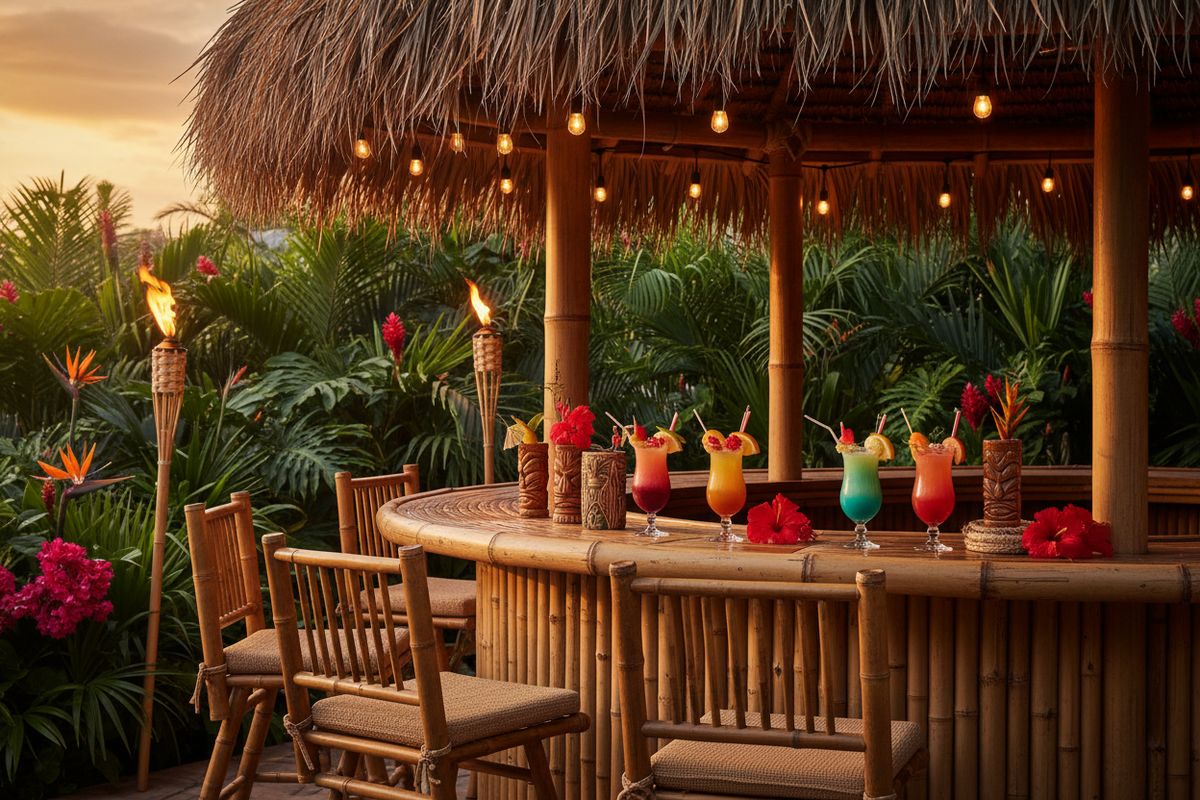
If you step into a classic tropical resort, an open-air pavilion in Bali, or a vintage mid-century lounge, one material almost always sets the scene: bamboo. It forms the soaring rooflines, bends into comfortable armchairs, and lines partition screens with a warm, golden sheen.
To many modern eyes, bamboo furniture and design evoke a feeling of relaxed island living—a sun-drenched aesthetic forever linked to beachside escapes, tiki culture, and tropical retreats.
Yet, treating bamboo as merely a tropical decor trend overlooks one of humanity’s oldest, most engineered, and most ecologically sophisticated building materials. Long before it became a staple of tropical resorts and mid-century living rooms, bamboo was the structural backbone of civilizations across Asia, the South Pacific, and the Americas.
Part I: The Miracle Grass (Engineering by Nature)
To understand why bamboo became the foundation of tropical architecture, you have to appreciate what it actually is. Bamboo is not a tree; it is a giant, fast-growing grass.
Some species of bamboo can grow up to three feet in a single 24-hour period. While a hardwood tree like oak or teak can take 50 to 100 years to reach maturity, a bamboo culm (stalk) reaches its full height and structural strength in just three to five years.
                   [ BAMBOO CULM CROSS-SECTION ]
 ┌───────────────────────────────────────────────────────────────┐
 │                                                               │
 │   Dense Outer Wall              Hollow Center                 │
 │  (High Tensile Strength)       (Reduces Weight + Flexes)      │
 │        ░░░░░                      ┌───────┐                   │
 │       ░░░░░░░                     │       │                   │
 │      ░░░░░░░░░                    └───────┘                   │
 │                                                               │
 │   Node Ring (Distributes load and prevents splitting)         │
 └───────────────────────────────────────────────────────────────┘
From an engineering perspective, a stalk of bamboo is a masterpiece of natural design:
-
High Tensile Strength: Weight for weight, the outer fibers of certain bamboo species (like Guadua or Dendrocalamus) have a tensile strength that rivals steel, allowing it to withstand tremendous pulling forces.
-
Flexibility under Load: Because the center of the culm is hollow and interrupted by solid internal partitions called nodes, bamboo can bend dramatically in heavy winds or earthquakes without snapping.
-
Lightweight Efficiency: Its hollow structure makes it easy to transport and assemble by hand without requiring heavy machinery or draft animals.
In tropical regions prone to typhoons, monsoons, and seismic activity, these physical traits made bamboo the ideal building material. A heavy stone or concrete house might collapse during a major earthquake, but a flexible bamboo frame sways with the earth, absorbing the kinetic energy and keeping its inhabitants safe.
Part II: Vernacular Roots—The Traditional Tropical Dwelling
Across tropical Asia and the Pacific islands, traditional bamboo architecture developed out of a deep harmony with local climates.
In the Philippines, the traditional rural house—the Bahay Kubo (nipa hut)—was engineered around bamboo. Raised high on sturdy bamboo stilts (haligi) to protect against seasonal flooding, snakes, and damp ground, the home featured woven bamboo walls (sawali) and slatted bamboo flooring.
                [ TRADITIONAL TROPICAL DWELLING ]
 ┌───────────────────────────────────────────────────────────────┐
 │                                                               │
 │               ▲ High Pitch Roof (Rapid Rain Runoff)           │
 │              / \                                              │
 │             /   \                                             │
 │            /     \                                            │
 │     ┌─────┴───────┴─────┐                                     │
 │     │  Woven Bamboo     │  Slatted Bamboo Floor               │
 │     │  Walls (Sawali)   │  (Passive Ventilation)              │
 │     └─────┬───────┬─────┘                                     │
 │           │       │                                           │
 │           │       │  Bamboo Stilts (Elevated for Flooding)    │
 └───────────┴───────┴───────────────────────────────────────────┘
This open-slat flooring allowed cool breezes to rise naturally from underneath the house while letting dust and debris fall through. The high-pitched, thatched roofs quickly shed heavy monsoon rains.
Similar traditions flourished elsewhere: the Bale houses of Indonesia, traditional bamboo longhouses in Borneo, and the Bahareque structures of Colombia and Ecuador, which combined bamboo frames with mud plaster to create resilient, climate-smart homes.
In these traditional cultures, furniture was sparse. People sat, slept, and ate on low woven bamboo mats (banig or tatami). When bamboo furniture was built, it was light, portable, and designed for open-air living, resisting the humidity that would quickly rot heavy textiles or warp thick solid woods.
Part III: The Global Journey—From Imperial Courts to European Salons
As international trade routes expanded in the 17th and 18th centuries, bamboo items began traveling across the globe alongside silk, tea, and porcelain.
In China and Japan, bamboo furniture-making had already evolved into a refined art form. Master craftsmen used heat to bend bamboo stalks into elegant, curved armchairs, tea tables, and scholars' cabinets. Unlike Western furniture, which relied heavily on metal nails or screws, traditional Asian bamboo furniture was joined using carved bamboo pins, mortise-and-tenon joints, and tight rattan lashings.
When these pieces arrived in Europe during the height of the 18th-century Chinoiserie trend, wealthy aristocrats fell in love with their exotic look. Demand grew so high that European furniture makers began producing "faux bamboo" pieces—carving maple, beech, or brass to mimic the distinct nodes and golden hue of real bamboo culms.
| Era / Style | Primary Material Used | Key Cultural / Design Characteristics |
| Traditional Vernacular | Raw bamboo stalks + rattan lashing | Flexible, climate-adaptive, elevated on stilts, open airflow |
| 18th-Century Chinoiserie | Imported bamboo & "Faux Bamboo" wood | Luxury European decor mimicking East Asian imperial style |
| Victorian Conservatory | Bent bamboo + rattan weaving | Lightweight, moisture-resistant furniture for sunrooms |
| Mid-Century Modern / Tiki | Steam-bent bamboo, pole bamboo, rattan | Warm, tropical escapism blended with sleek organic curves |
By the late Victorian era, sunrooms, plant conservatories, and seaside cottages across Britain and North America were outfitted with lightweight bamboo tables, magazine racks, and bentwood chairs, establishing bamboo as the global symbol of leisure and indoor-outdoor living.
Part IV: Mid-Century Modernism and the Tiki Boom
In the mid-20th century, bamboo design underwent a dramatic transformation.
Following World War II, American design embraced Mid-Century Modernism, prioritizing organic shapes, natural materials, and seamless transitions between indoor and outdoor spaces. Iconic designers like Paul Frankl, Gabriella Crespi, and Franco Albini began experimenting with steam-bent bamboo, pole bamboo, and its close structural relative, rattan.
At the same time, the rise of Tiki Culture brought a theatrical wave of tropical escapism to American suburbs. Restaurants, apartment complexes, and home tiki bars featured thick bamboo poles lining the walls, bamboo-framed mirrors, and plush bamboo lounge chairs.
                    [ BENDING & JOINERY ]
                               │
            ┌──────────────────┴──────────────────┐
            ▼                                     ▼
     [ Heat / Steam ]                    [ Rattan Lashing ]
 (Softens fibers to curve poles)       (Binds structural joints)
            │                                     │
            └──────────────────┬──────────────────┘
                               ▼
                 [ MID-CENTURY BAMBOO CHAIR ]
           (Combines structural strength with curves)
Bamboo was no longer seen merely as an exotic souvenir or a rustic cottage material; it became a symbol of mid-century sophistication—warm, tactile, and effortlessly stylish.
Part V: The Contemporary Renaissance
Today, bamboo is undergoing an architectural revolution.
As the world seeks sustainable building materials to replace carbon-heavy concrete and steel, architects and engineers are rediscovering bamboo with cutting-edge technology. Pioneering design firms—particularly in Indonesia, Vietnam, and South America—are creating breathtaking, multi-story bamboo structures with soaring open arches and dramatic cathedrals of curved grass.
Modern preservation techniques, such as treating raw bamboo with natural borate salts, have solved bamboo’s historical weakness: its susceptibility to insects and moisture decay. Treated bamboo can now last for decades, even centuries, without losing its structural integrity.
From ancient flood-resilient dwellings in Southeast Asia to iconic mid-century living rooms and modern eco-resorts, bamboo's journey is a testament to its extraordinary nature. It remains one of the world's most versatile, beautiful, and sustainable gifts—a simple grass that continues to shape how we live, relax, and build.