The Trader Vic and the Peg-Leg Empire: The Life and Legacy of Victor Bergeron
By Scott Southworth · August 18, 2026
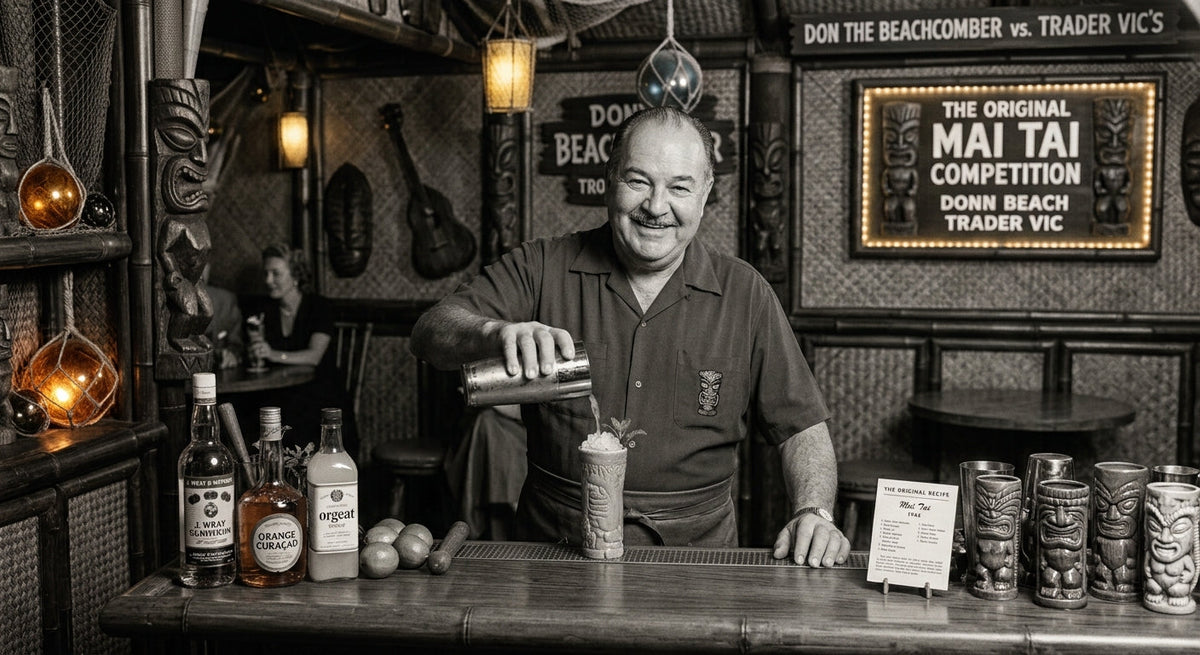
If you have ever ordered a Mai Tai at an open-air bar, carved into a rack of lamb cooked over an ancient-style Chinese wood oven, or chuckled at a restaurant menu filled with dry, self-deprecating wit, you have crossed paths with Victor Jules Bergeron Jr.
To the culinary world, he was simply Trader Vic—a one-legged, straight-talking, wildly charismatic saloonkeeper from Northern California who turned a $500 loan into a global empire of tropical luxury.
While his arch-rival Donn Beach was the brooding artist who dreamed up the theatrical look of Tiki, Victor Bergeron was the pragmatic powerhouse who brought it to the masses. He was a master host, a savvy marketer, and an uncompromising stickler for fresh, top-tier ingredients long before the term "farm-to-table" ever existed.
Part I: Hinky Dinks and the $500 Gamble
Born in San Francisco in 1902 to a French-Canadian family of grocery clerks and cooks, young Vic Bergeron learned the rhythms of hospitality early in his family’s food stalls. But his childhood was marked by a devastating blow: at age six, a severe illness (likely tuberculosis of the bone or polio) led to the amputation of his left leg below the knee.
Rather than letting a disability define him, Vic developed an unstoppable, irreverent sense of humor. When curious restaurant guests later asked how he lost his leg, Vic would lean in with a straight face and spin elaborate lies—claiming it was bitten off by a shark in the South Pacific, shot off in a gunfight, or lost while saving a damsel in distress.
                    [ VICTOR J. BERGERON JR. ]
                                │
            ┌───────────────────┴───────────────────┐
            ▼                                       ▼
    [ San Francisco ]                      [ 1934: Oakland ]
 (Grocery stalls & cooking)             (Opens "Hinky Dinks" saloon)
            │                                       │
            └───────────────────┬───────────────────┘
                                ▼
                   [ 1937: TRADER VIC'S BORN ]
            (Transforms hunting lodge into tropical sanctuary)
In 1934, during the depths of the Great Depression, Vic borrowed $500 from his landlord to open a tiny, square-shaped beer parlor and hunting lounge on 65th Street in Oakland, California. He called it Hinky Dinks.
To stand out, Vic served strong drinks, cooked hearty food, and traded free meals and drinks to local sailors and travelers in exchange for strange artifacts, snowshoes, carved masks, and sea shells to mount on the walls. Because he was constantly trading food for decor and supplies, his wife, Ella, gave him a nickname that would change history: Trader Vic.
Part II: The Transformation (From Saloon to Tropical Sanctuary)
In 1937, after taking a trip to Los Angeles and visiting Donn Beach’s groundbreaking Hollywood bar, Vic experienced an epiphany. He saw the future of American dining: complete, immersive escapism.
Vic returned to Oakland, shut down Hinky Dinks, and reopened it as Trader Vic’s. He stripped down the hunting-lodge aesthetic, wrapped the building in reed mats and bamboo poles, hung canoes from the ceiling, and installed massive wood-fired Chinese ovens.
                  [ THE TRADER VIC'S FORMULA ]
 ┌───────────────────────────────────────────────────────────────┐
 │                                                               │
 │   Authentic Chinese Ovens   +   Fresh Tropical Cocktails      │
 │  (Oak-wood, high-heat roasting)  (1944 Mai Tai, Fog Cutter)   │
 │                                                               │
 │                   +  Unmatched Hospitality                    │
 │                   ("Tell it like it is" charm)                │
 │                                                               │
 │                               =                               │
 │                  THE GLOBAL EMPIRE (1950s-70s)                │
 │            (San Francisco, Chicago, London, Tokyo)            │
 └───────────────────────────────────────────────────────────────┘
Vic’s genius lay in bridging high-end dining with relaxed tropical atmosphere. While traditional upscale French restaurants of the era were stiff and intimidating, Trader Vic’s was vibrant, fun, and delicious.
He pioneered Polynesian-American fusion cuisine, cooking prime ribs, squab, and pork racks in tall, cylindrical brick ovens heated by sweet-smelling oak logs. He introduced mainstream America to crab rangoon, rumaki, and glazed spare ribs—pairing them with rum cocktails served in custom ceramic bowls meant for sharing.
| Hospitality Aspect | Traditional Fine Dining (1940s-50s) | Trader Vic's Experience |
| Atmosphere | Stiff, formal, quiet white-tablecloth rooms | Dimly lit, tropical, exotic music, warm bamboo wood |
| Service Style | Formal tuxedos, distant demeanor | Attentive, jovial, relaxed, theatrical presentation |
| Cooking Method | Standard broilers and stovetops | Custom 6-foot oak-fired Chinese barbecue ovens |
| Cocktail Focus | Standard Martinis, Manhattans, Highballs | Hand-shaken rum classics with fresh lime & rare fruit |
Part III: The 1944 Mai Tai and Culinary Integrity
Trader Vic’s greatest liquid legacy was born on an autumn afternoon in 1944. Standing behind his Oakland bar, Vic picked up a bottle of 17-year-old Wray & Nephew Jamaican rum. Wanting to create a cocktail that showcased the rich, funky depth of the spirit rather than masking it, he added fresh lime juice, French orgeat (almond syrup), orange curaçao, and a splash of rock candy syrup.
He shook it over crushed ice, garnished it with a fresh mint sprig and a spent lime shell, and served it to two friends from Tahiti. Upon taking a sip, one famously shouted, "Mai Tai—Roa Aʻe!" ("Out of this world—the best!"). The Mai Tai was born.
                      [ THE 1944 MAI TAI ]
                               │
            ┌──────────────────┴──────────────────┐
            ▼                                     ▼
 [ 17-Yr Jamaican Rum ]                  [ Fresh Citrus & Syrups ]
 (Wray & Nephew funky depth)           (Lime, Orgeat, Curaçao, Rock Candy)
            │                                     │
            └──────────────────┬──────────────────┘
                               ▼
               "MAI TAI - ROA AʻE!" (The Original)
Beyond drinks, Vic was obsessed with quality control. Long before organic food movements, he established his own farms, imported his own spices, and wrote strict training manuals for his chefs. He wrote dozens of cookbooks, published humorous memoirs, and released a commercial line of salad dressings, marinades, and drink mixes that sold nationwide in supermarkets.
Part IV: The Global Empire and the Royal Favorite
By the 1950s and 60s, Trader Vic’s wasn't just a local restaurant—it was an international status symbol.
Conrad Hilton partnered with Bergeron to open Trader Vic’s locations inside luxury Hilton hotels around the globe, from Chicago and New York to London, Munich, and Tokyo. World leaders, movie stars, and royalty flocked to his tables.
                    [ THE GLOBAL EXPANSION ]
                              │
            ┌─────────────────┴─────────────────┐
            ▼                                   ▼
 [ Conrad Hilton Partnership ]         [ Royal & Celebrity Fame ]
(Hotels in NYC, Chicago, London)    (Queen Elizabeth II, Hollywood stars)
            │                                   │
            └─────────────────┬─────────────────┘
                              ▼
                "The World's Premier Resort Dining"
When Queen Elizabeth II visited San Francisco in 1983, her only requested private dinner outside official diplomatic functions was at Trader Vic’s. She dined on oak-roasted lamb and drank Vic’s signature cocktails while the elderly Trader—wearing his trademark oversized glasses and cheeky smile—chatted with her at the table.
The Legacy of a Self-Made Legend
Victor Bergeron passed away in 1984 at the age of 82. He remained active in his business until his final days, often spending his later years painting, sculpting ceramics, and checking in on his flagship locations.
Today, while many mid-century trends have come and gone, the Trader Vic’s brand still operates original locations worldwide—from the Middle East to Europe and Asia.
Trader Vic proved that dining out shouldn't be a cold, formal ritual; it should be an adventure. Through his sharp culinary mind, infectious humor, and unwavering commitment to quality, the kid with a wooden leg from Oakland turned a simple $500 saloon into a timeless, global celebration of life, food, and paradise.