Throne of Pop Culture: The Origins, History, and Iconography of the Vintage Peacock Chair
By Scott Southworth · October 15, 2026
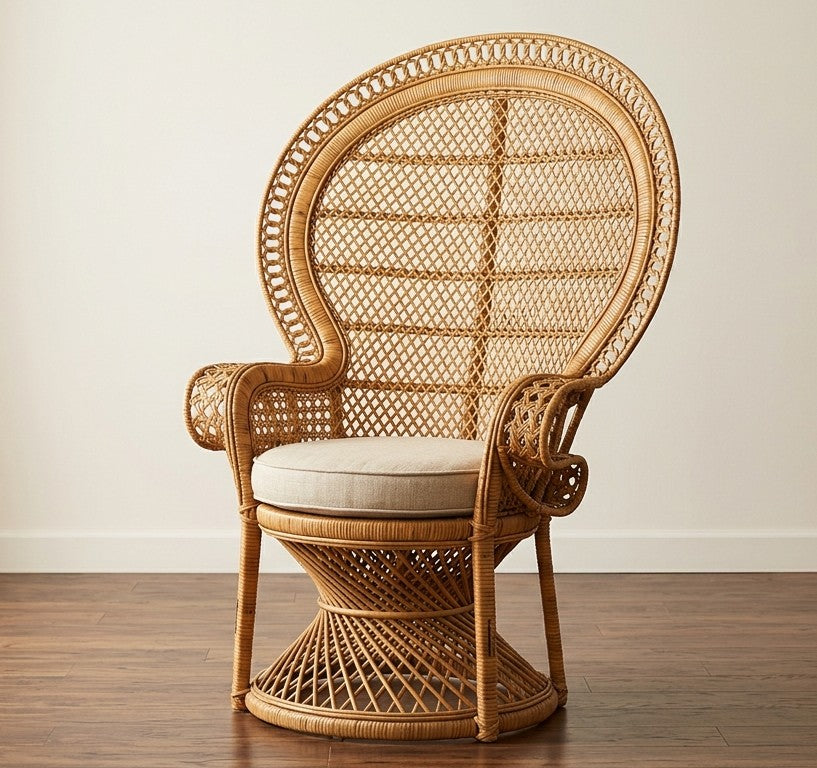
Few objects in the history of interior design command a room quite like the Peacock Chair.
With its soaring, flared fan-back resembling the majestic display of a male peacock, intricately woven lattice patterns, and commanding pedestal base, it is more than just a piece of furniture. It is a throne.
Though widely associated with 1960s and 70s bohemian counterculture, Hollywood glamour, and the Black Panther Party, the true origins of the peacock chair stretch back across empires, Victorian colonies, and traditional Asian craft lineages.
Dont forget, if you'd add a little extra fun tiki decor to your bar, home, or lounge you can find your Bamboo Framed Tiki Breezeway Tiles here.
Part I: Imperial Roots (Colonial Prisons and Asian Craft)
The exact lineage of the peacock chair is shrouded in a blend of Victorian colonial history and traditional basketry. Most historians trace its birth to the late 19th century in Bilibid Prison in Manila, Philippines, during the American colonial period, though similar woven fan-back styles were crafted in Hong Kong, Canton, and Java.
                  [ EVOLUTION OF THE PEACOCK CHAIR ]
                                  │
      ┌───────────────────────────┼───────────────────────────┐
      ▼                           ▼                           ▼
[ PRISON LABOR ]          [ COLONIAL EXPOSITIONS ]   [ HOLLYWOOD GLAMOUR ]
Bilibid Prison (Manila)   1904 St. Louis World's Fair  1920s-50s Silver Screen
Woven rattan & cane       Introduced to American public  Portraits of starlets
Under the penal system established in Manila, prisoners were taught skilled trades, particularly woodworking and basket weaving. Inmates began producing ornate, large-scale wicker chairs utilizing native rattan and split-cane vines.
These chairs were built using steam-bent structural frames surrounded by layers of intricate lace-like weaving. The oversized, circular back panels were designed to evoke a regal halo or throne, transforming a humble woven seat into an imposing statement of status.
These pieces caught the attention of Western colonial officials and merchants. By the early 1900s—most notably showcased at the 1904 St. Louis World's Fair—these elaborate wicker creations were exported to the United States and Europe, where wealthy Victorians eagerly snapped them up for sunrooms, verandas, and exotic plant conservatories.
Part II: Hollywood Golden Age and Mid-Century Exoticism
As the Victorian era gave way to the 20th century, the peacock chair found a natural home in Hollywood. Studio photographers realized that the massive, textured fan-back created an unmatched framing device for portrait subjects.
During the 1920s through the 1950s, Hollywood starlets—including Dorothy Lamour, Gloria Swanson, and Marlene Dietrich—were frequently photographed posing regally inside giant wicker peacock thrones.
                       [ HOLLYWOOD TO TIKI ERA ]
                                   │
         ┌─────────────────────────┴─────────────────────────>
         ▼                                                   ▼
 [ GLAMOUR PORTRAITS ]                               [ TIKI BARS & RESORTS ]
 Framed starlets with texture                        Lined open-air Polynesian
 and regal elegance                                  lounges and restaurant booths
With the post-WWII explosion of Tiki culture, interior designers looking for tropical statement pieces imported thousands of peacock chairs from Hong Kong and the Philippines. They became standard furnishings in upscale Polynesian restaurants, hotel lobbies, and suburban sunrooms, cementing their association with leisure, tropical escapism, and relaxed luxury.
Part III: The 1960s Counterculture and the Black Panther Iconography
By the late 1960s, the peacock chair crossed over from elite Hollywood studios and tiki bars into the heart of the global counterculture movement. Its associations shifted from colonial luxury to radical liberation, bohemian rebellion, and Afrocentric pride.
The defining visual moment of the chair's political history occurred in 1967, when Huey P. Newton, co-founder of the Black Panther Party, was photographed inside a wicker peacock chair in Oakland, California.
                    [ THE ICONIC 1967 PHOTOGRAPH ]
                                  │
            ┌─────────────────────┴─────────────────────┐
            ▼                                           ▼
 [ HUEY P. NEWTON ]                           [ SYMBOLIC POWER ]
 Seated with spear & shotgun                Turned a colonial wicker chair
 in a peacock throne                        into a modern throne of resistance
In the photograph, Newton holds a spear in one hand and a shotgun in the other, posed formally like an African king. The juxtaposition of the woven wicker "throne" with armed revolutionary resistance turned the peacock chair into an instant cultural icon of Black power, sovereignty, and defiance against oppression.
Following the widespread publication of the image, musicians, artists, and bohemians embraced the chair. Morton Downey Jr., Sylvia Syms, and numerous rock and soul musicians posed in peacock chairs for album covers and press shoots, cementing its status as the ultimate seat of 1970s cool.
Part IV: Identifying and Sourcing Vintage Peacock Chairs
With genuine vintage peacock chairs highly sought after by collectors and interior designers today, distinguishing authentic mid-century or antique pieces from modern reproductions is essential.
                    [ AUTHENTICATION CHECKLIST ]
 ┌─────────────────────────────────────────────────────────────────┐
 │                                                                 │
 │   1. Construction Weight  ──► Vintage chairs are heavy & dense  │
 │   2. Cane vs. Synthetic   ──► Natural rattan vs. plastic resin  │
 │   3. Weave Complexity     ──► Tight, flawless geometric lace    │
 │   4. Base Construction    ──► Sturdy hourglass spool pedestal   │
 │                                                                 │
 └─────────────────────────────────────────────────────────────────┘
-
Weight and Density: Genuine vintage peacock chairs made from dense Philippine or Asian rattan are surprisingly heavy and rigid. Modern reproductions often use lightweight, flimsy bamboo or hollow synthetic cores that flex easily under pressure.
-
Material Integrity: Examine the weave closely. True vintage pieces feature natural cane bindings holding thick structural ribs together. Look for a warm, honeyed amber patina that only decades of aging can produce.
-
The Pedestal Base: Classic peacock chairs feature an hourglass or spool-shaped woven pedestal base that distributes weight evenly beneath the wide seat.
Care and Restoration
Because vintage peacock chairs are woven from natural plant fibers, they require gentle care:
-
Dusting: Use a soft-bristle vacuum attachment to clear dust from tight woven crevices.
-
Conditioning: To prevent the brittle dry-rot common in vintage wicker, apply a light coat of boiled linseed oil or natural beeswax using a soft cloth, keeping the vines supple and glowing.
The Enduring Throne
From colonial workshops in Manila to Hollywood portrait studios, 1960s revolutionary posters, and modern bohemian living rooms, the vintage peacock chair has transcended its origins. It remains a masterclass in organic design—a welcoming, theatrical throne that transforms any space it inhabits into a stage.